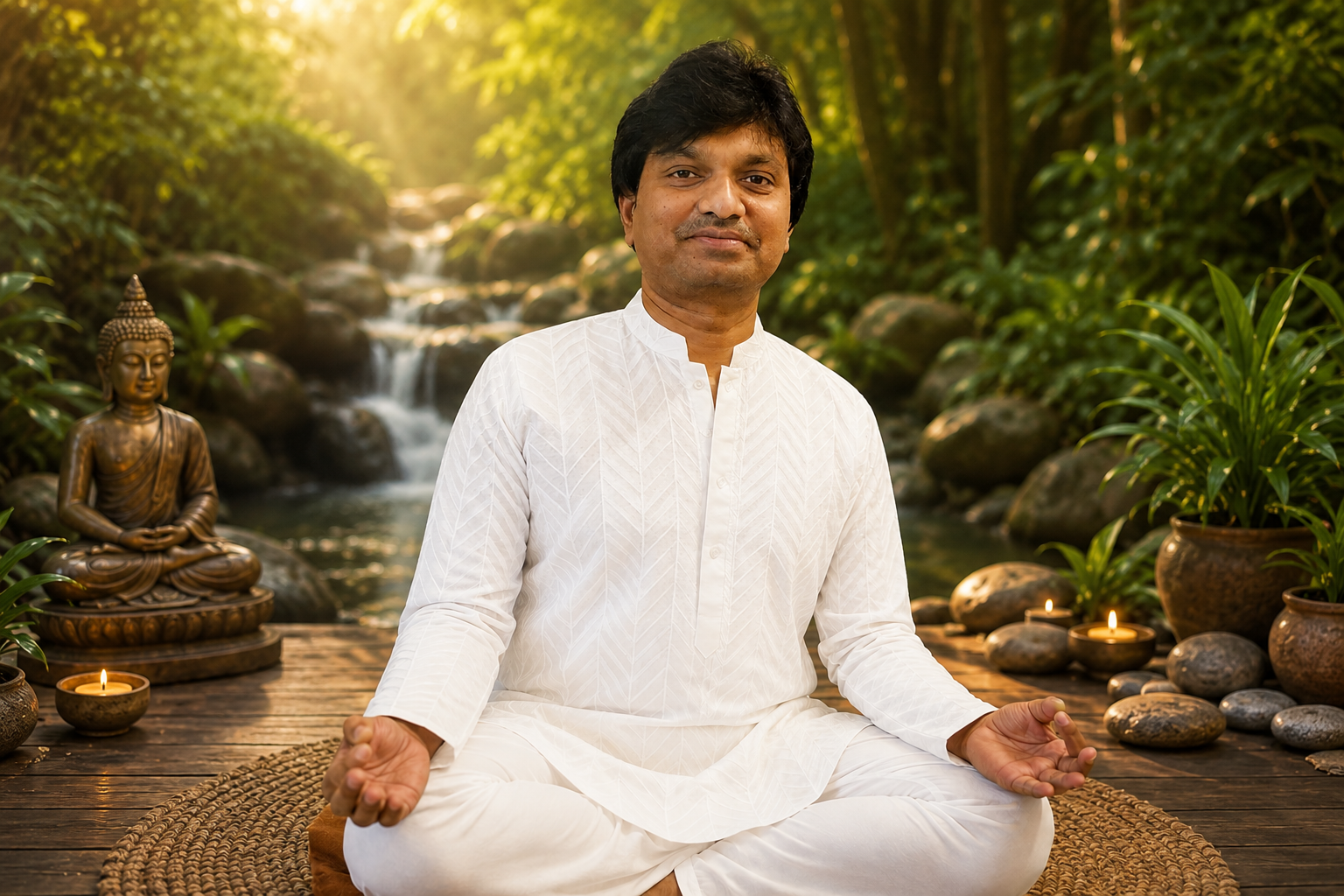
How Dr. Hari Krishna Demystifies Meditation through Physics and Biology?
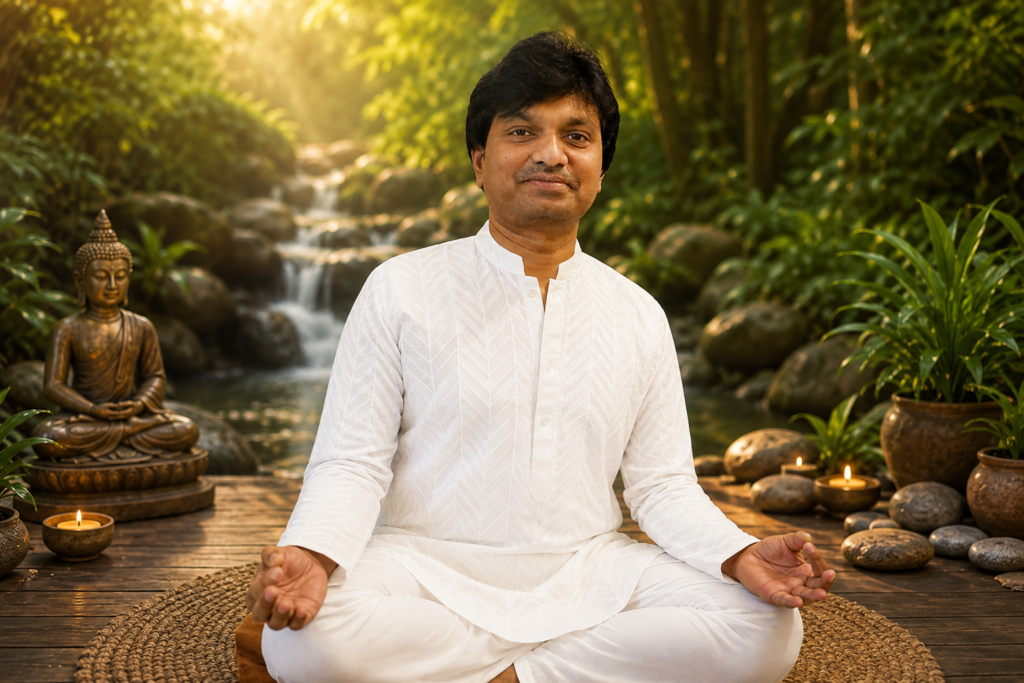
Meditation has often been described as a mystical practice, but Dr. Hari Krishna, through the Golden Age Spiritual Movement, presents it as a science of stillness. His mission is to explain Dhyanam derived from Dhi (intellect) and Yanam (journey) in a way that blends ancient wisdom with modern physics and biology. By doing so, he helps practitioners move past beginner struggles and discover meditation as a logical, experiential process rather than an abstract ritual. His approach is not about blind belief but about observation, experimentation, and inner transformation, making meditation accessible to seekers who value both spirituality and science.
One of his most striking teachings is the bio-electromagnetics of posture. He instructs meditators to clasp their hands and cross their legs, forming what he calls a “closed circuit.” This posture, he explains, establishes a toroidal electromagnetic field a self-sustaining loop of energy that circulates within the body instead of leaking outward. Much like a magnet’s field, this torus keeps vital energy contained, allowing the practitioner to conserve and redirect it inward. In this way, posture is not merely symbolic but a practical tool for energy management, grounding meditation in the language of physics.
As the body settles into stillness, another transformation begins: the metabolic slowdown. Dr. Hari Krishna describes how meditation naturally reduces the Body Metabolic Rate (BMR), lowering oxygen demand and slowing the resting breath. This shift is reflected in the Hamsa cycle, where the breath drops from the usual 15 to 16 breaths per minute to a slower, more refined rhythm. He likens this to the body entering a state of deep conservation, where energy is no longer wasted on unnecessary activity. The Hamsa breath becomes a gateway to inner silence, a biological marker of meditation’s power to harmonize body and mind.
Beyond the physical, meditation is also about mastering the mind. Dr. Hari Krishna introduces the concept of the Sakshi, the Observer, who watches thoughts without entanglement. His framework includes seven practical rules, guiding practitioners to treat thoughts like passing clouds or cars on a highway. Instead of waging mental warfare, the meditator learns detachment, allowing the mind to settle naturally. This approach transforms meditation from a struggle into a practice of awareness, where the Observer remains calm even as thoughts arise and dissolve.
The chemistry of meditation is equally fascinating. Slowed breathing activates the parasympathetic nervous system, shifting the brain into a restorative mode. In this state, the body releases a cocktail of hormones Oxytocin, Melatonin, Serotonin, and Endorphins. These “happy hormones” bring about physical numbness, deep relaxation, and the joy known as Asana Siddhi. Dr. Hari Krishna emphasizes that these effects are not mystical illusions but measurable outcomes of meditation’s impact on the nervous system. The practitioner experiences peace and bliss not as abstract ideals but as tangible biochemical realities.
At advanced stages, meditation becomes a form of spiritual fasting. Known as Pratyahara, this practice involves withdrawing from external stimuli and allowing the wisdom sheath, or Vijnanamaya Kosha, to access alternative cosmic energy. When physical breathing slows to near stillness, the Sahasrara, or crown chakra, activates, opening the practitioner to higher dimensions of consciousness. Dr. Hari Krishna compares this to fasting, where the body abstains from food to cleanse itself. In meditation, the soul abstains from external distractions, nourishing itself with cosmic energy instead. This crown activation marks the culmination of meditation as both science and spirituality.
Through these teachings, Dr. Hari Krishna bridges the gap between ancient wisdom and modern understanding. His explanations of posture, breath, mind, chemistry, and crown activation show that meditation is not an esoteric ritual but a scientific journey of stillness. By presenting Dhyanam as both intellect and journey, he empowers seekers to explore meditation logically, experientially, and spiritually. In a world burdened by stress and distraction, his science of stillness offers a path to balance, clarity, and inner transformation.
NeoSouth has steadily built a loyal readership, and Dr. Hari Krishna’s articles on meditation science have become some of the most widely read features on the platform. Recent analytics show that his explorations into Dhyanam, posture bio-electromagnetics, and the chemistry of meditation have been read by more than 2.5 lakh people, underscoring the growing public interest in blending spirituality with scientific explanation. This readership milestone reflects both the credibility of his work and the resonance of NeoSouth’s editorial mission to present devotional knowledge in a modern, accessible way.