Beyond Carbon Dating: Ancient Human Proof
Human history is far older than the limits of carbon dating can reveal. While carbon-14 analysis has been a powerful tool for archaeologists, it only works up to about 50,000 years. Yet, discoveries of fossils, stone tools, and genetic evidence show that humans and their ancestors existed hundreds of thousands of years earlier. This deeper timeline challenges our understanding of how civilizations began and how humanity evolved across continents.
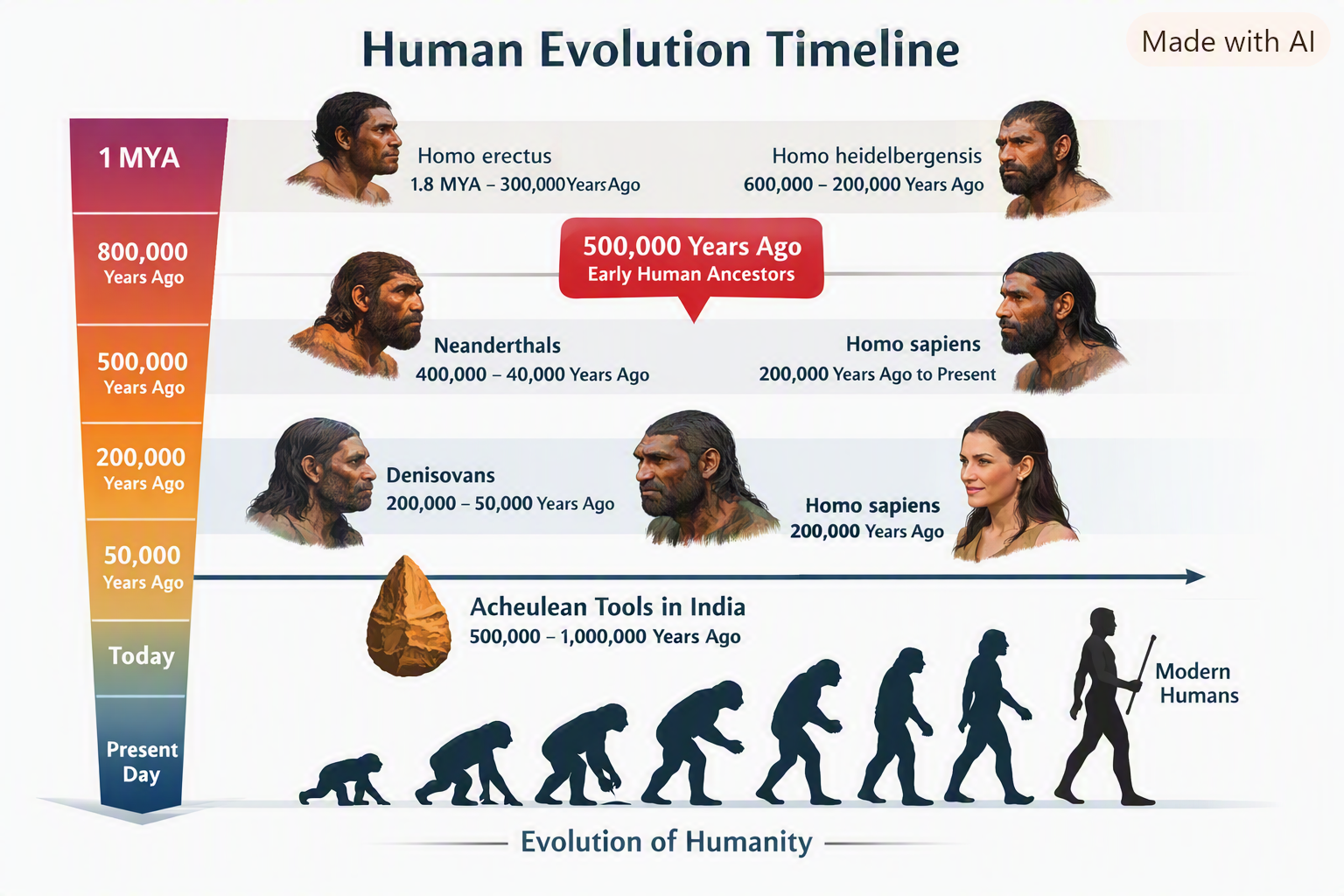
Archaeological sites across Africa, Europe, and Asia have revealed fossils of archaic humans dating back nearly half a million years. Species such as Homo heidelbergensis and Homo erectus thrived long before modern humans appeared. Their remains, found in caves and ancient riverbeds, provide undeniable proof that human existence stretches far beyond the reach of carbon dating. These findings are supported by advanced techniques like uranium-series dating and electron spin resonance, which can measure ages up to a million years.
Genetic research adds another layer of evidence. DNA comparisons between modern humans, Neanderthals, and Denisovans show that our lineage split around 500,000–700,000 years ago. This means that by the time carbon dating reaches its limit, humanity had already diversified into multiple branches. These genetic timelines align with fossil discoveries, strengthening the case for human existence well beyond 5 lakh years.
In India, the story is equally fascinating. While skeletal fossils are rare, stone tools discovered in Andhra Pradesh and Telangana reveal human activity dating back 500,000–1,000,000 years. Acheulean hand axes and other artifacts prove that early humans lived, hunted, and thrived in the subcontinent long before recorded history. These tools are silent witnesses to a forgotten chapter of human civilization, connecting India to the global story of human evolution.
The limitations of carbon dating often lead to misconceptions. Many assume that if carbon dating cannot measure beyond 50,000 years, then human history must be younger. In reality, science has developed multiple dating methods to overcome this boundary. Uranium-series dating, for example, measures the decay of uranium in cave deposits and teeth, while electron spin resonance analyzes trapped electrons in fossils. These techniques extend our vision into the half-million-year range, revealing a much older human past.
The discovery of ancient human fossils in China, Africa, and Europe has reshaped our timeline. Skulls from Yunxian in China, dated to around 800,000 years, show features of both archaic and modern humans. In Africa, fossils of Homo heidelbergensis bridge the gap between Homo erectus and Homo sapiens. These findings prove that humanity’s journey was not linear but a complex web of evolution, migration, and adaptation.
Stone tools remain one of the strongest proofs of human existence beyond carbon dating. Unlike bones, which decay, tools survive for millennia. The Acheulean hand axes found in India, Africa, and Europe are remarkably similar, suggesting that early humans shared knowledge across continents. These artifacts are more than tools; they are cultural fingerprints of humanity’s earliest innovators.
The blending of archaeology and genetics has created a new era of discovery. Fossils provide physical evidence, while DNA reveals hidden connections. Together, they confirm that humans existed long before carbon dating could measure. This synergy of science ensures that our understanding of human history is not limited by technology but expanded by innovation.
For India, these discoveries are a source of pride and curiosity. The presence of ancient tools in Andhra Pradesh and Telangana shows that the subcontinent was part of humanity’s earliest chapters. It connects modern Indians to a lineage that stretches back half a million years, reminding us that our roots are deeper than written history.
In conclusion, the proof of human existence beyond carbon dating is undeniable. Fossils, tools, and DNA all point to a timeline that extends far beyond 50,000 years. Humanity’s story is not confined to recent millennia but stretches into the distant past, where early humans carved tools, built communities, and laid the foundation for civilization. This knowledge not only enriches science but also inspires us to see ourselves as part of a vast, ancient journey.