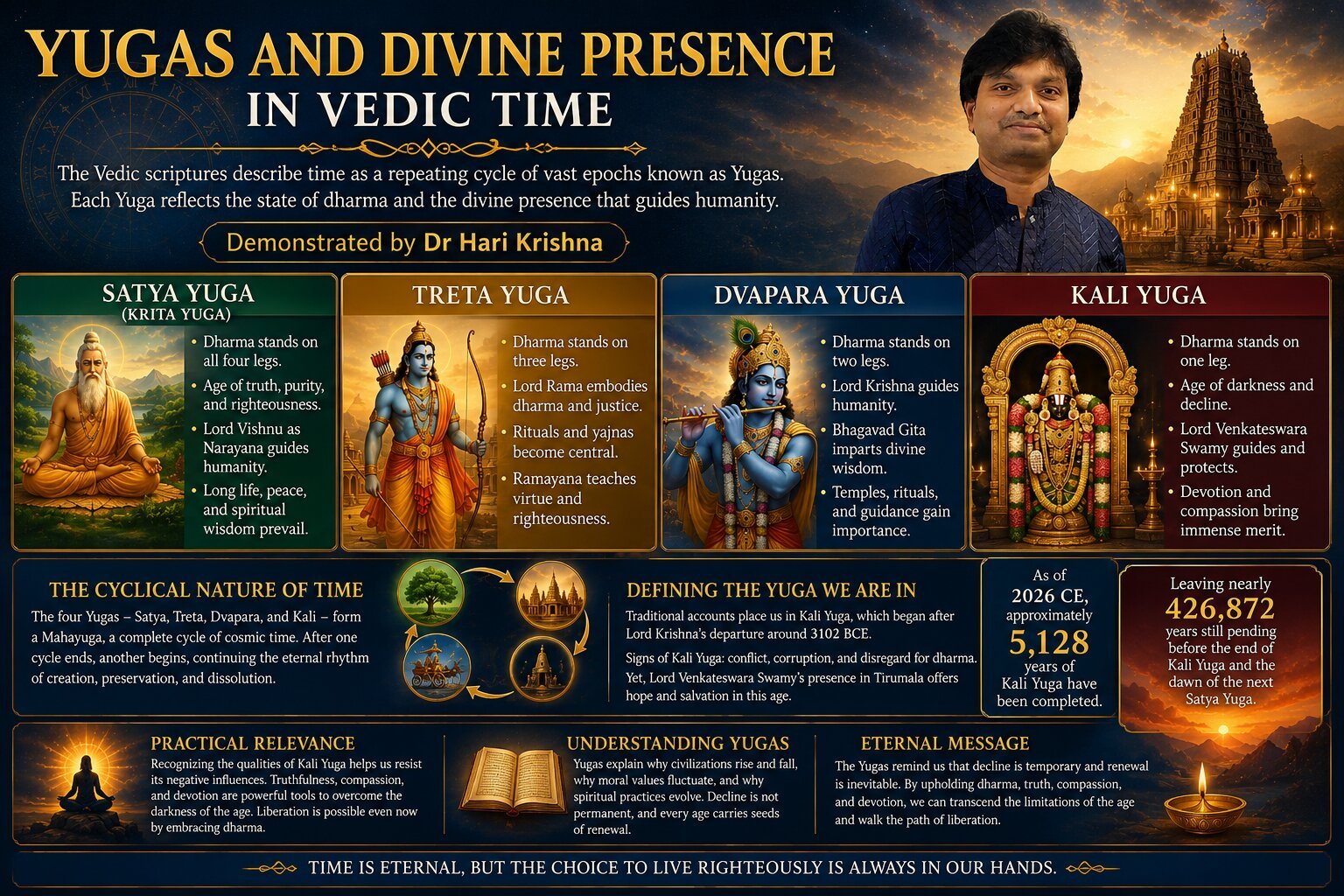
Yugas and Divine Presence in Vedic Time Demonstrated by Dr Hari Krishna
The Vedic scriptures describe time as a repeating cycle of vast epochs known as Yugas. These Yugas define the moral, spiritual, and social state of humanity across ages, each carrying its own characteristics and divine guidance. Together, the four Yugas Satya, Treta, Dvapara, and Kali form a Mahayuga, a complete cycle of cosmic time spanning millions of years. This cyclical view of existence emphasizes that decline and renewal are natural, reminding humanity that dharma rises and falls in rhythm with the universe.
Satya Yuga, also called Krita Yuga, is revered as the golden age of truth and righteousness. In this epoch, dharma stands firmly on all four legs, symbolizing complete harmony. Human beings live long lives free from disease, naturally inclined toward spiritual pursuits. Lord Vishnu, in His Narayana form, is the guiding divine presence, embodying purity and truth. The atmosphere of Satya Yuga is one of effortless wisdom, where humanity remains deeply connected to the cosmic order.
Treta Yuga follows, marking the decline of dharma to three legs. While righteousness still prevails, material desires begin to influence human behavior. This is the age of Lord Rama, whose life and rule exemplify dharma and justice. The Ramayana narrates the struggles between virtue and vice, showing how divine incarnations guide humanity back to righteousness. Rituals and yajnas become central to spiritual practice, and kings are expected to uphold dharma in governance.
Dvapara Yuga comes next, where dharma stands on two legs, symbolizing further decline. This epoch is marked by conflict, division, and the rise of materialism. Lord Krishna, the divine incarnation of Vishnu, becomes the guiding force, offering humanity the Bhagavad Gita’s wisdom. The Mahabharata belongs to this age, reflecting the struggle for dharma amidst greed and power. Temples and rituals gain importance, as structured guidance is needed to maintain spiritual connection.
Kali Yuga, the age we are said to be living in now, is described as the age of darkness and decline. Dharma stands on only one leg, symbolizing the dominance of falsehood and selfishness. Yet, Kali Yuga is also unique, for devotion and simple acts of compassion yield immense spiritual merit. Lord Venkateswara Swamy of Tirumala is revered as the living divine presence guiding humanity in this age. Scriptures also foretell the arrival of Lord Kalki at the end of Kali Yuga, but until then, Venkateswara Swamy is worshipped as the protector and savior of devotees.
The Yugas are not merely historical periods but cosmic cycles that repeat endlessly. Each Mahayuga, consisting of the four Yugas, is followed by another, continuing the eternal rhythm of creation, preservation, and dissolution. This cyclical wisdom contrasts with modern linear views of time, reminding us that decline is temporary and renewal inevitable. The divine presence in each Yuga ensures that humanity is never left without guidance.
Defining which Yuga we are in today has been debated by scholars and spiritual teachers. Traditional accounts place us firmly in Kali Yuga, which began after Lord Krishna’s departure around 3102 BCE. Signs of Kali Yuga are evident in widespread conflict, corruption, and disregard for dharma. However, many devotees believe that Lord Venkateswara Swamy’s presence in Tirumala offers hope and salvation, making Kali Yuga a time of spiritual opportunity despite its challenges. As of 2026 CE, approximately 5,128 years of Kali Yuga have been completed, leaving nearly 426,872 years still pending in this epoch.
The practical relevance of Yugas lies in their ability to inspire reflection on our current state of life. By recognizing the qualities of Kali Yuga, individuals can consciously resist its negative influences and cultivate virtues associated with earlier ages. Acts of truthfulness, compassion, and devotion become powerful tools to counter the darkness of the age. The Vedas encourage humanity to rise above limitations by embracing dharma, reminding us that liberation is possible even now.
Understanding Yugas also provides a broader perspective on history and human progress. It explains why civilizations rise and fall, why moral values fluctuate, and why spiritual practices evolve. The Yugas remind us that decline is not permanent, and every age carries seeds of renewal. This cyclical wisdom encourages patience, resilience, and faith in the cosmic order, assuring us that humanity’s journey is guided by divine rhythm.
In conclusion, the definition of Yugas according to Vedic scriptures is not just philosophical but practical. Whether we accept that we are in Kali Yuga or anticipate a new Satya Yuga, the message remains clear: dharma must be upheld, and spiritual awareness nurtured. By aligning our lives with truth and compassion, we transcend the limitations of the age. The Yugas remind us that time is eternal, but the choice to live righteously is always in our hands.
Kali Yuga has completed about 5,128 years since 3102 BCE, leaving nearly 426,872 years pending before its end and the dawn of the next Satya Yuga.
Satya Yuga (Krita)
- Duration: 1,728,000 years
- Associated Deity: Lord Vishnu as Narayana (embodiment of truth)
- Status: Completed in past cycles
Treta Yuga
- Duration: 1,296,000 years
- Associated Deity: Lord Rama (incarnation of Vishnu, ruler of dharma)
- Status: Completed in past cycles
Dvapara Yuga
- Duration: 864,000 years
- Associated Deity: Lord Krishna (incarnation of Vishnu, Bhagavad Gita guidance)
- Status: Completed in past cycles
Kali Yuga
- Duration: 432,000 years
- Associated Deity: Lord Venkateswara Swamy (present form of Vishnu) and future Lord Kalki
- Years Completed: ~5,128 years (from 3102 BCE to 2026 CE)
- Years Pending: ~426,872 years remaining
Mahayuga (all four Yugas)
- Duration: 4,320,000 years
- Associated Deity: Complete cycle of Vishnu’s manifestations
- Status: Ongoing
Kali Yuga, though marked by decline, is also blessed with the living presence of Lord Venkateswara Swamy, guiding devotees through devotion and compassion. With about 5,128 years completed and nearly 426,872 years remaining, this age reminds us that dharma must be upheld even in challenging times. The Yugas are eternal cycles, but the choice to live truthfully and righteously rests with us, ensuring that humanity continues its journey toward renewal and divine grace.