MGNREGA Renaming Sparks Nationwide Protests
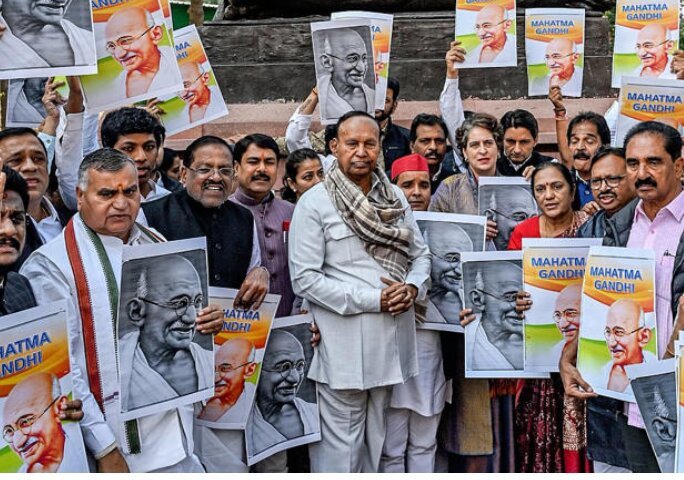
The proposed overhaul of India’s massive rural employment scheme, previously known as the Mahatma Gandhi National Rural Employment Guarantee Act (MGNREGA), has triggered a major political confrontation both inside and outside Parliament. The government recently introduced the new bill, known as the Viksit Bharat – Guarantee for Rozgar and Ajeevika Mission (Gramin), or VB-G RAM G, which seeks to repeal and replace the existing legislation. The move has been met with immediate and strong protests from various opposition parties and workers’ rights groups across the country.
At the heart of the controversy is the perceived dilution of a fundamental right and the dropping of Mahatma Gandhi’s name from the scheme’s title. Critics argue that the name change, regardless of the new acronym, is an attempt to erase the legacy of the Father of the Nation from a program that serves the poorest sections of rural India. Senior political leaders have publicly questioned the rationale behind changing a universally recognized and transformative law, pointing out the unnecessary expenditure and disruption that rebranding entails.
Beyond the name, the new bill introduces several fundamental changes to the scheme’s structure, which activists claim will fundamentally weaken the rights of rural workers. The existing MGNREGA operates as a demand-driven, legal entitlement for 100 days of work per household annually, with the central government bearing the full wage cost. In contrast, the VB-G RAM G Bill proposes a shift to a normative allocation model. Under this new approach, the central government will fix an annual budget for each state based on pre-determined parameters.
A major concern for state governments is the altered funding pattern. The new bill proposes a cost-sharing ratio of 60:40 between the Centre and most states for both wage and material components, a significant change from the current system where the Centre shoulders the entire wage bill. State leaders from various political parties have raised alarms that this shift will impose a heavier and potentially unsustainable financial burden on state exchequers, effectively limiting their capacity to meet the actual demand for work.
While the new legislation proposes to increase the guaranteed work days from 100 to 125 per household, this increase is offset by a controversial new provision. The bill allows states to notify a total of up to 60 days of ‘no-work’ during peak agricultural seasons to ensure labour availability for farming. Critics argue that this provision undermines the work guarantee and may be used to deny work when poor families need it most.
Furthermore, the new law mandates the use of advanced digital tools, including biometric authentication and geo-spatial monitoring, for worker attendance and project tracking. While aimed at improving transparency and curbing corruption, workers’ representatives warn that mandatory technology use often creates exclusion in remote areas where reliable connectivity and technology literacy are low. The entire debate has escalated into a major ideological battle, with the Opposition vowing to oppose the bill strongly in Parliament, characterizing it as an assault on the poor’s livelihood security and an act of centralizing power away from the Gram Panchayats.