The Anthem’s Echo, Vande Mataram Ignites Political Conflict
The powerful legacy of India’s national song, Vande Mataram, has once again erupted into a major political flashpoint, dominated by intense debate and sharp accusations between the ruling and opposition parties. This renewed conflict centres on historical narratives surrounding the song’s adoption and perceived modifications dating back to the pre-Independence era.
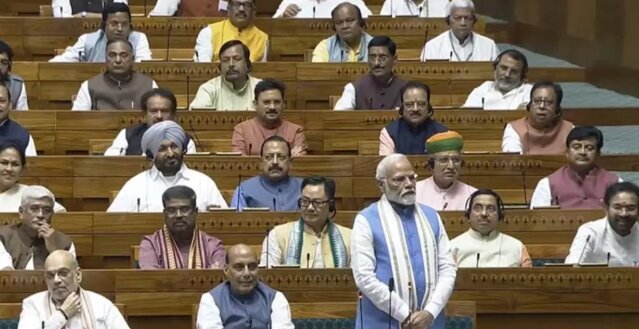
The current dispute was triggered by recent discussions in Parliament commemorating the song’s 150th anniversary. The Prime Minister, in his address, alleged that the Congress party, particularly in the 1937 working committee meeting, made a fundamental error by truncating crucial stanzas of Vande Mataram. The core of this charge is that this decision, which was reportedly made to address the concerns of certain communities regarding the song’s religious imagery, was an act of political “appeasement” that compromised the song’s original, unifying spirit and, by extension, sowed the seeds of the country’s eventual partition.
The Opposition, particularly the Congress, has vehemently rejected this revisionist narrative. They assert that their leaders, including Mahatma Gandhi, Jawaharlal Nehru, and Subhas Chandra Bose, were the ones who first popularised the song as a battle cry of the freedom movement, enduring British bans and repression. They maintain that the 1937 decision to adopt only the first two stanzas was a deliberate act of inclusivity and national unity, not betrayal. The decision was based on expert advice, including that of Rabindranath Tagore, who had set the song to music, acknowledging that the later verses contained religious symbolism that could be seen as exclusionary. The Opposition leaders accuse the government of using this historical debate as a political weapon to distract from pressing contemporary issues such as unemployment, economic inequality, and foreign policy challenges, especially with upcoming state elections in mind.
Authored by Bankim Chandra Chatterjee in the 1870s and popularised through his novel Anandamath, Vande Mataram, which translates to “I bow to you, Mother,” became an unparalleled symbol of national pride during the anti-British struggle, most notably during the Partition of Bengal in 1905. The first two stanzas, which simply celebrate the motherland, were widely embraced across all communities. However, the song’s subsequent inclusion in the novel, featuring an ascetic army fighting a foreign power and the later stanzas invoking Hindu goddess imagery, led to some objections, particularly from sections of the Muslim community who found the deification of the motherland to be incompatible with their faith’s monotheism. The current political argument essentially reopens this old, sensitive rift, framing it as a choice between absolute cultural symbolism and historical pluralism.
The debate underscores the powerful role of historical memory and cultural symbols in modern Indian politics. Both sides leverage the song’s legacy to reinforce their respective ideologies of nationalism. While the ruling party presents its stand as a mission to restore the original glory of a civilizational symbol, the opposition frames its defense as a necessity to protect the inclusive, pluralistic values of the freedom movement. What remains clear is that Vande Mataram, whether in its full or truncated form, continues to be a profound expression of devotion to the nation, inspiring citizens even as it fuels partisan disagreements in the political arena. The discussion is a timely reminder that the meanings of powerful national symbols are constantly contested and redefined in a vibrant democracy.