Srirangam / Lord Ranganatha (Divya Desam)
The island cradled by the mighty Kaveri and Kollidam rivers, known to the world as Srirangam, is home to a living marvel of faith—the Sri Ranganathaswamy Temple. This sacred space is not merely a temple but is revered as the foremost, the Adi Rangam, among the 108 holy shrines of Lord Vishnu, collectively known as the Divya Desams. Its sheer scale—it is one of the largest functional religious complexes on the planet—only hints at the depth of the history and devotion embedded within its seven concentric walls. To the devotees of the Sri Vaishnava tradition, this place holds the title of Bhuloka Vaikundam, the very Heaven of Vishnu manifested upon Earth.
The Divine Purpose of Appearance
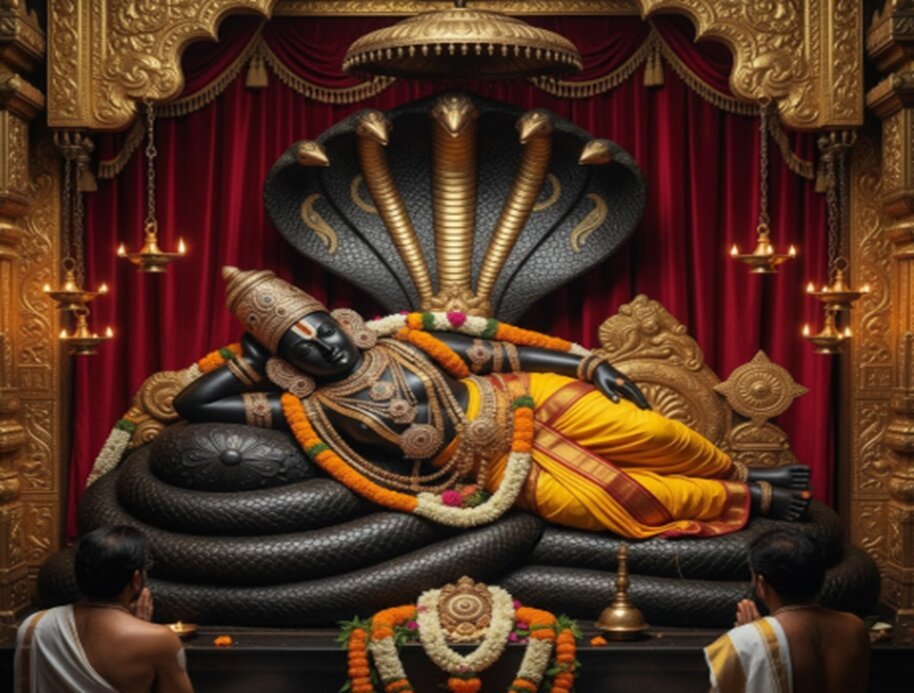
The magnificent central deity, Sri Ranganatha, lies in a serene reclining posture, an image of divine rest that marks the profound origin story of the temple. The sacred idol, known as the Ranga Vimana, is believed to have been received by Lord Brahma himself during a deep state of meditation in Satya Loka, the celestial abode. Brahma, the creator, worshipped this form of Vishnu for aeons, a testament to its supreme antiquity and power. Through the lineage of the Sun Dynasty (Ikshvaku dynasty), the Vimana came to be worshipped by the great King Ikshvaku, and ultimately passed down to Lord Rama, the seventh incarnation of Vishnu, who revered it daily in Ayodhya. The divine purpose for the deity’s presence on Earth, however, was sealed after the victory over Ravana. In an act of profound gratitude, Lord Rama gifted the precious Ranga Vimana to Vibhishana, Ravana’s virtuous brother and new king of Lanka, as a token of love and blessing.
It was during Vibhishana’s journey back to Lanka that the deity chose this particular spot on the Kaveri river banks for his eternal resting place. Resting the Vimana temporarily on the ground to participate in a local festival, Vibhishana found that the idol could not be lifted again. Lord Ranganatha had grown fond of the place, specifically the confluence of the rivers, and refused to move, citing a promise he had made to the River Kaveri herself—that he would forever rest upon her banks. A heartbroken Vibhishana prayed fervently. In an act of immense compassion and grace, the Lord consoled his devotee and promised that even while residing here, he would perpetually face the South, the direction of Lanka, ensuring his benevolent gaze and blessings were always directed towards Vibhishana’s kingdom. Thus, the deity in the sanctum sanctorum of Thiruvarangam continues to face South to this day, an enduring symbol of a divine promise fulfilled.
Main Legends and Miracles: The Love that Broke Barriers
The history of Thiruvarangam is interwoven with key legends and miracles that demonstrate the Lord’s power to transcend human and religious barriers. One of the most cherished tales is that of Andal, also known as Kodhai. Found as an infant under a Tulsi plant and raised by the priest Periyalwar, Kodhai grew up with an intense, personal devotion to Lord Ranganatha, viewing him as her divine bridegroom. Her unique act of devotion involved first wearing the garlands meant for the Lord to ensure they were perfect, a practice her father discovered and chastised her for. However, the deity himself appeared in the priest’s dream, demanding only the garlands worn by Kodhai—the Soodikodutha Sudarkodi (the one who wore and then gave the garland). This miracle culminated in Andal merging with the Lord in the sanctum, a powerful testimony to the strength of Bhakti (pure devotion) and a spiritual elevation that placed her among the revered twelve Alwars, the saint-poets of Vaishnavism.
Another compelling story speaks to the turbulent medieval history of the temple. During one of the invasions by the Delhi Sultanate in the 14th century, the deity’s processional idol was carried away to Delhi. The Sultan’s daughter, Surathani, saw the idol and instantly fell in love, becoming completely devoted to the Lord, whom she called Azhagiya Manavaalan (the beautiful bridegroom). When the devotees of Srirangam recovered the idol and returned it, the princess, unable to bear the separation, followed them to Thiruvarangam. It is believed she offered her last prayers before the Lord’s sanctum and attained moksha, merging with the divine light. In her memory and to honour her selfless love, a niche known as Thulukha Nachiyar (the Muslim Goddess) was established within the temple complex, where she is offered food, symbolizing the Lord’s acceptance of devotion from every creed and background.
Profound Symbolism and Spiritual Significance
The deity’s form is rich with symbolism. Lord Ranganatha lies in Bhujanga Sayanam, resting upon the coils of the thousand-headed serpent, Adishesha. This posture is not one of ordinary sleep, but Yoganidra, the conscious cosmic sleep where the universe is contained within the Lord, signifying his role as the source and sustenance of all creation. Adishesha, the eternal servant, acts as the royal canopy, symbolizing duty and devotion. The seven concentric enclosures, or prakarams, of the temple complex are a potent piece of spiritual geometry. These walls are said to represent the seven worlds or seven layers of the universe, with the sanctum sanctorum at the innermost core symbolizing the Atman (soul) residing within the seven elements that constitute the human body. The very atmosphere is steeped in the essence of sacred texts, as the temple became a vital centre for spiritual inquiry under the leadership of the great philosopher-saint Ramanuja in the 11th century.
Worship and Grand Festivals
The practices of worship at Srirangam are carried out with meticulous adherence to the Vaikhanasa Agama tradition. Devotees offer their prayers to Sri Ranganatha, known as Periya Perumal, and his consort, Sri Ranganayaki Thayar. The calendar of Thiruvarangam is punctuated by grand festivals, the most significant being the 21-day Vaikuntha Ekadashi festival, which falls in the Tamil month of Margazhi (December-January). The highlight is the opening of the Paramapada Vasal (or Swarga Vasal), the ‘Gateway to Heaven.’ Passing through this gateway on this auspicious day is believed to grant the devotee direct access to Vaikuntha, the celestial abode. Another important celebration is the Brahmotsavam, a ten-day event marked by elaborate processions and rituals, showcasing the deity’s majestic form, attracting pilgrims from all corners of the world and keeping the tradition vibrant.
The Eternal Spiritual Message
The spiritual message emanating from Thiruvarangam is profoundly universal: the path to salvation is paved with Prapatti, or unconditional surrender to the divine. The reclining posture of Ranganatha, the Bhuloka Vaikundam on an island, conveys that the ultimate liberation, which is often sought in faraway heavens, is available right here, in the midst of worldly life, through the simple act of devotion and surrender. The stories of Andal and the Muslim princess teach that the Lord’s love and grace are accessible to anyone, regardless of their social standing, background, or religious label. The spiritual core of the temple emphasizes that compassion and bhakti are the highest virtues, and that the Divine is ever-present, ready to embrace the faithful soul. Thiruvarangam stands as an eternal invitation to find the celestial peace of Vaikuntha on Earth, a message that offers hope and solace to all humanity.
Written By Anirudha Miryala (Anumaa) Founder of Way To Moksha